

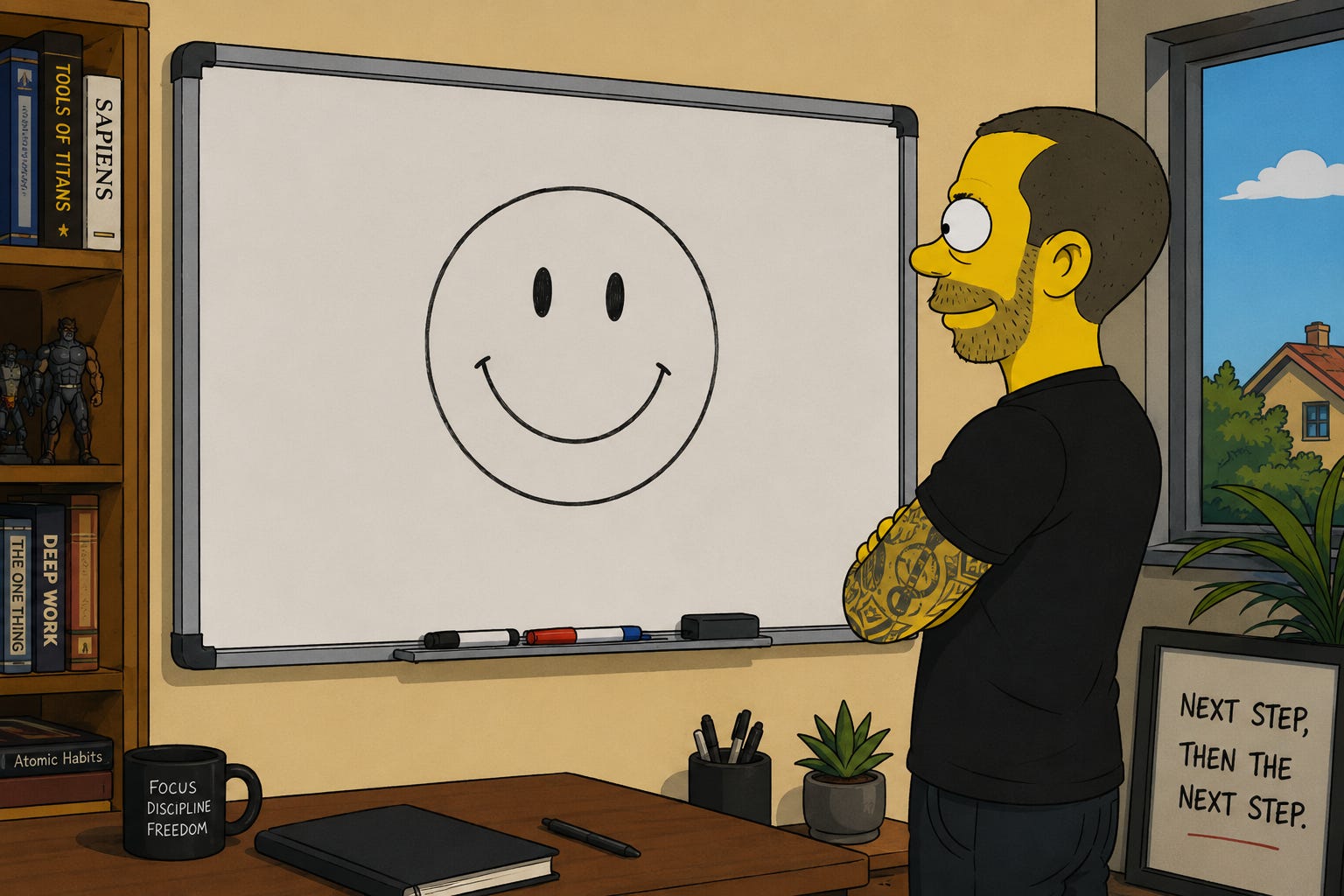
At some point during every working day, I stop what I’m doing, swivel my chair around, and stare at the wall.
This is not meditation. There are no breathing exercises involved. I’m looking at three whiteboards.
They sit in my office next to shelves of collectables, which probably says quite a lot about me. On one side: objects from the past that I’ve decided are worth keeping. On the other: a constantly changing picture of what I’m supposed to be doing next.
The boards are covered mostly in black marker, with occasional bursts of red. There’s nothing particularly sophisticated about them. No productivity guru would be able to sell you a twelve-week course based on the system. You could reproduce the whole thing with three boards, two pens and about an hour of thought.
But they’ve become one of the most useful tools I have.
What I like about a whiteboard is that it refuses to disappear.
A notebook can be closed. An app can be ignored. A spreadsheet can sit untouched behind seventeen browser tabs. But a large white rectangle attached to the wall is still there every time you turn around.
And sometimes that’s exactly what I need.
The first board keeps the machinery running
My first whiteboard is the most orderly of the three. It contains daily, weekly and monthly checklists.
These are the things that need doing repeatedly if I want life and business to keep functioning without everything slowly descending into chaos.
Most of them aren’t particularly exciting. That’s almost the point.
The glamorous parts of any project are rarely what cause problems. It’s the boring things you forget to do consistently.
Everything is written in black. When something gets done, it gets a red tick.
There’s a small satisfaction in those red marks appearing across the board. Not enough to turn me into someone who gets excited about productivity apps, but enough to make progress visible.
At the end of the relevant period, it gets rubbed out.
That detail matters to me.
I don’t cross things out and leave them sitting there as some sort of archaeological record of productivity. Once something is done, it has served its purpose. It disappears and the board gets used again.
The interesting part is that the categories aren’t fixed.
Something might begin on the daily list because I want to build a habit or pay close attention to it. A month later, I may realise daily is ridiculous and move it to weekly.
Weekly things sometimes become monthly.
Occasionally something moves in the other direction because circumstances have changed and it suddenly deserves more attention.
I think that flexibility is important.
People have a strange tendency to create systems and then become employees of their own systems.
They decide that something must happen every morning because six months ago they wrote “daily” next to it, even though the task stopped being useful sometime around Easter.
I have no loyalty to an old decision just because I made it.
Everything is subject to change.
The board exists to help me. I don’t exist to maintain the board.
The second board is where ambition meets reality
The second board is probably the one I look at most carefully.
Part of it is simply cash in and cash out.
Nothing fancy. It isn’t trying to replace accounting software or proper financial records. I just want the basic movement of money somewhere I can see it.
Money has become strangely invisible.
It arrives as numbers on a screen and leaves as different numbers on another screen. Cards get tapped. Direct debits happen silently. Subscriptions nibble away in the background. You can be earning plenty, spending plenty and working constantly without ever stopping to ask the obvious question:
Is more coming in than going out?
Putting it on the wall makes it real again.
The same board also contains my yearly goals, and I deliberately limit them to four or five.
I could write twenty…….. Anyone can write twenty.
“I want to get fitter, earn more, travel more, learn Japanese, renovate the house, build a business, read fifty books, become more present, meditate daily and finally sort out that cupboard.”
Wonderful.
You now have a list of things you will mostly not do.
Four or five forces me to choose.
And usually one of those goals is marked in red because that’s THE ONE receiving most of my attention right now.
That doesn’t mean the other goals have stopped mattering. It means I’ve accepted the fairly obvious fact that I cannot push five major things forward with equal force at the same time.
You can have several priorities across a year.
You probably shouldn’t have several priorities at 10:30 on Tuesday morning.
Red tells me: this one now.
Below the yearly goals are four or five goals for the current month.
This is where vague ambition starts having to explain itself.
A yearly goal can hide quite comfortably behind phrases like “grow the business” or “finish the house.”
A monthly goal has to answer a more awkward question.
What are you actually going to do?
That’s a much more useful conversation.
The same board also contains things I need to do around the house and tattoo studio.
Some of those jobs sit there longer than I’d like.
But at least they’re sitting there because I have consciously not done them yet, rather than because they vanished into whatever mysterious part of the brain stores forgotten jobs involving gutters, doors and broken lights.
There’s a difference between postponing something and forgetting it exists.
The board keeps me honest about which one I’m doing.
The third board is deliberately messier
The third whiteboard is more free-flowing.
This is where larger projects get reduced to their next steps.
The full project might live somewhere else. There may be notes, documents, calculations, plans or another board dedicated to it.
But on this board I don’t need the full complexity.
I need to know what happens next.
Big projects have an unfortunate habit of presenting themselves to the brain all at once.
A house renovation isn’t one task. It’s fifty tasks wearing a trench coat.
Starting a business isn’t one task either. It’s branding, pricing, writing, recording, websites, payments, marketing, tax, customers and approximately seven things you didn’t know existed until yesterday.
Look at the entire project at once and it becomes intimidating.
Look at the next step and it becomes manageable.
Write the article.
Record the episode.
Get the quote.
Send the email.
Connect the domain.
Make the phone call.
Do that, rub it out, then write down what comes next.
This sounds almost insultingly simple, but simple is useful.
Projects rarely unfold exactly as planned anyway. One completed step can make the next three irrelevant. Something unexpected appears. A new opportunity changes the order. An idea that looked brilliant two months ago turns out to be completely unnecessary.
So the board changes.
Frequently.
I don’t regard that as the plan failing.
The plan is supposed to change when reality provides better information.
Black and red
My colour-coding system would horrify anyone who owns a twelve-pack of pastel markers.
Black is information.
Red means something is active, important or completed.
That’s basically it.
If I finish something, red tick.
If I have five yearly goals and one is the current focus, that one gets red.
I don’t need blue for finance, green for health, orange for urgent-but-not-important and purple for things that sounded like a good idea after two glasses of wine.
Too many categories and suddenly you need a legend explaining your own brain.
Black and red work because I can understand the board from across the room.
And that’s important, because the whole point is that I don’t always need to sit directly in front of it and study it.
Sometimes I’m working at my computer, I get stuck, and I swivel around.
That change in physical position is surprisingly useful.
The view from the chair
This is the bit I don’t think apps or sticky notes quite replicate.
A whiteboard is big.
You see the whole thing at once.
When I turn around, I can see recurring routines, monthly priorities, money, house jobs and the next actions on bigger projects without clicking through anything.
I can physically stand back from it.
That changes the way you think.
A computer screen encourages you to focus on whatever is currently open. That’s extremely useful when you need concentration, but it can also create tunnel vision.
Whatever is on the screen starts feeling like the most important thing in the world.
The whiteboards remind me that it might not be.
Maybe I’ve spent forty minutes perfecting something that doesn’t actually matter.
Maybe a much more important job has been sitting on the wall untouched for ten days.
Maybe I’ve already made far more progress this month than I realised.
Visibility changes behaviour.
It’s difficult to pretend something is a priority when you’ve been staring at it for three weeks and haven’t moved it forward.
That doesn’t necessarily mean you’re lazy.
Maybe the next step isn’t clear enough.
Maybe the project is wrong.
Maybe something else genuinely matters more.
Sometimes procrastination is information.
The board makes that information harder to hide from.
Whiteboards are temporary, which is exactly the point
Perhaps my favourite feature of a whiteboard is that everything written on it expects to disappear eventually.
There’s something liberating about that.
Plans have a tendency to become emotionally expensive once we’ve written them down. We start defending an old decision because changing it feels like admitting we were wrong.
A whiteboard doesn’t care.
Rub it out.
A daily task becomes weekly.
A goal disappears completely.
A project gets postponed.
A new priority arrives.
Something you thought mattered enormously in January can be irrelevant by August.
Fine.
The board is not a contract with your former self.
It is a picture of what matters now.
That’s closer to how strategy actually works.
You set a direction, act, collect information, adjust, and act again.
The alternative is blindly following a plan while reality quietly wanders off in another direction.
Three boards, three questions
If I strip away everything written on them, my three whiteboards are really answering three questions.
The first asks: What needs to keep happening?
The second asks: What matters most?
The third asks: What happens next?
That covers a surprising amount.
Maintenance.
Direction.
Movement.
I’m not claiming three whiteboards will transform anyone’s life. If you hate whiteboards, buying three enormous ones and bolting them to your office wall is probably not the breakthrough you’ve been waiting for.
But I do think there’s something powerful about getting important thoughts out of your head and putting them somewhere you can actually see them.
For me, the physical nature matters.
I like being able to take a break from the screen, swivel my chair around and see the bigger picture.
Sometimes the answer I need is written on the board.
Sometimes staring at it makes me realise the question itself has changed.
And sometimes I simply notice a task that has been sitting there far too long, pick up the red pen, and decide it’s time to do the f*cking thing.