

There are thousands of books, podcasts, YouTube channels and very confident (mainly) men on the internet devoted to explaining how to become wealthy. They’ll tell you about stocks, property, Bitcoin, compound interest, tax efficiency, side hustles, passive income and often involving a yacht in Dubai.
Most of it comes later, like the yacht.
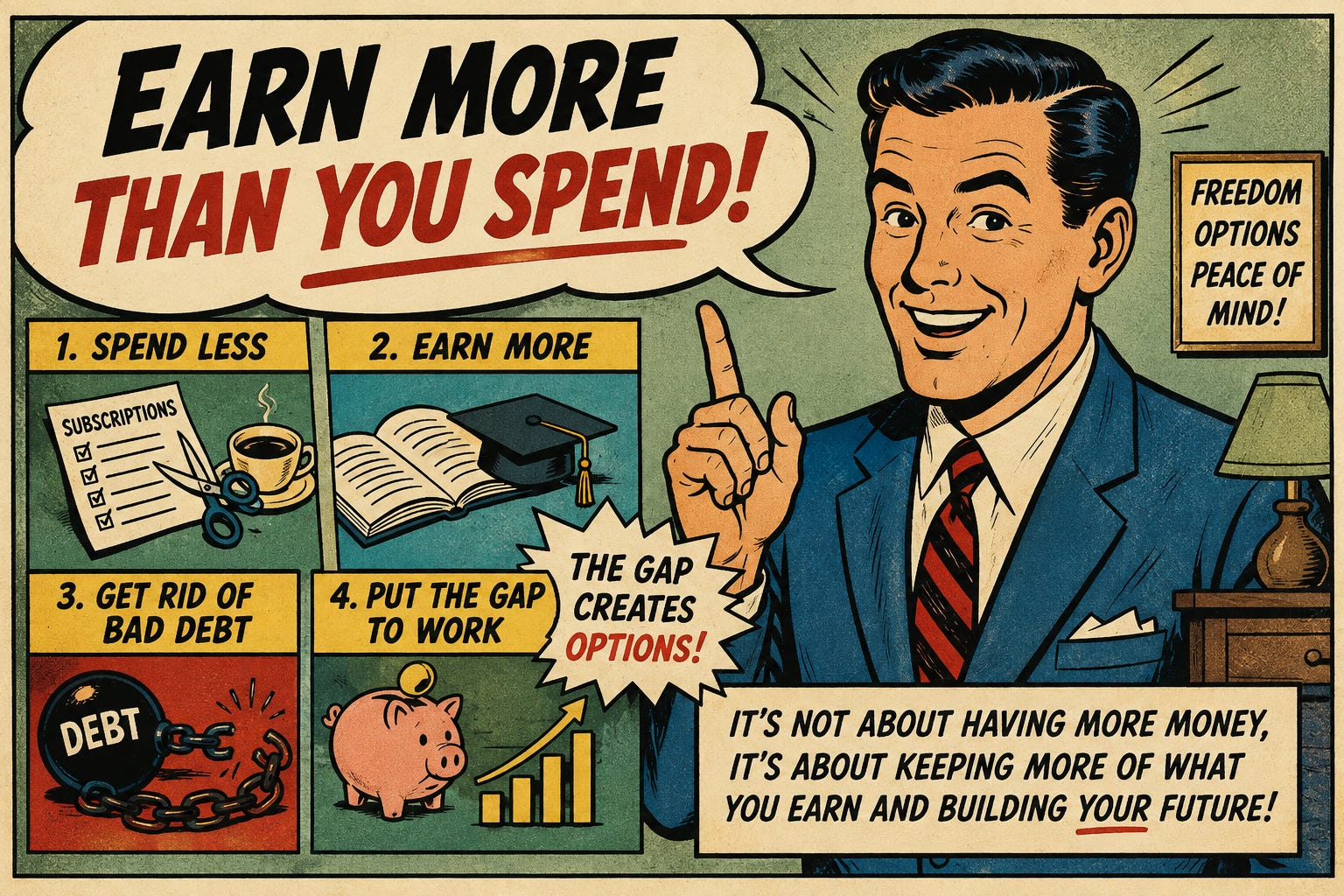
The first rule is embarrassingly simple: earn more than you spend.
You can dress it up, build spreadsheets around it and give it an impressive name, but almost every financial goal starts with the same basic requirement. More money needs to come into your life than leaves it. Whether you’re trying to get out of debt, build an emergency fund, start investing, buy a house, travel more or simply stop feeling slightly nervous every time an unexpected bill arrives, you need to build a gap.
And the bigger that gap becomes, the more interesting your life gets (if that’s actually possible :) ).
You can’t invest money that doesn’t exist
Personal finance discussions have a strange habit of beginning halfway through the story. People ask which ETF they should buy, whether Bitcoin is still worth owning, whether property is better than shares, or how much they should put into a pension. All good questions, but if your bank balance reaches zero (or sub-zero) before the month does, asset allocation probably isn’t the immediate problem.
You can’t invest your way out of a negative gap. Before worrying about returns, you need something left over to generate a return on. There are only two basic ways to create that surplus: spend less and earn more. Ideally, you do both.
Spending less is usually the quicker one because you can start today. Earning more is where the bigger long-term opportunity lies.
Find the leaks
The easiest money to save is often the money you barely remember spending.
Subscriptions are particularly good at this. A streaming service here, an app there, cloud storage, software, a gym membership, an insurance policy you haven’t reviewed since nobody had heard of TikTok.
Individually, none of them looks threatening. £8.99 doesn’t feel like a financial emergency, and neither does £12.99. Then you look through twelve months of statements and discover a small administrative ecosystem has evolved around you, quietly feeding itself every thirty days.
The answer isn’t to cancel everything enjoyable. I don’t want to live a life where financial optimisation means sitting in a dark room eating lentils while congratulating myself on my savings rate, unless that’s the goal for you….. Money is supposed to improve life.
But there’s a difference between deliberately spending money on something that improves your life and leaking money through inertia. If you use something and enjoy it, great. If you’d completely forgotten it existed until your bank statement reminded you, perhaps it deserves a second look.
The big numbers matter more
Personal finance advice also has a slightly strange obsession with tiny purchases. There are endless discussions about coffees and lunches, as though a cappuccino is the main obstacle standing between the average person and financial independence.
Small spending matters if there’s enough of it, but housing, transport and debt can dwarf almost everything else. Saving £3 on coffee is useful. Paying £400 less in rent is in a different league.
If you’re young and you have the opportunity to live somewhere rent-free or with very low rent for a period, that can be an extraordinary advantage. I know that isn’t possible for everyone, and I’m certainly not suggesting you should live in your childhood bedroom until you’re forty because some bloke on substack told you it was financially efficient.
But there are periods of life when deliberately keeping your biggest expenses low for a year or two can change the next decade. You might use that time to clear debt, build savings, start investing, learn a valuable skill or get a business off the ground.
The sacrifice only makes sense if you know what you’re buying with it. Living cheaply while spending the difference on rubbish achieves very little. Living cheaply while building a financial runway can be transformational.
Your past can spend your future
Bad debt is particularly destructive because it allows yesterday to keep sending invoices into tomorrow.
I’m not talking about every form of debt as though they’re identical. A manageable mortgage and a credit card balance charging painful interest because you bought things you couldn’t afford are clearly not the same animal. The second one actively attacks your margin.
Part of every future pay cheque is already spoken for before it arrives. That’s why getting rid of expensive consumer debt can be one of the best financial moves available to you. Every repayment you eliminate releases cash flow.
The money stops paying for something from the past and becomes available for something in the future. That is a much more satisfying direction of travel.
You can only cut so far
There is, however, an obvious problem with frugality. Eventually you run out of things to cut. You still need somewhere to live, you need food, transport, clothes, heating (and probably/maybe the occasional interaction with civilisation).
Expenses have a floor. Income is different.
Your ability to increase what you earn over a lifetime is much less fixed, and this is the side of personal finance I find more interesting. Cutting £100 a month is useful. Learning how to consistently earn another £1,000 a month can change your life.
That doesn’t necessarily mean working dramatically more hours. In fact, one of the best questions you can ask is not “How can I work more?” but “How can I make an hour of my work more valuable?”
Buy skills before stuff
There will be periods when working extra hours makes complete sense. If you’re clearing debt, building a business or trying to reach a specific target, a temporary push can be exactly what’s required. But there are only so many hours in a day, and eventually the better strategy is leverage.
Skills create leverage. Sales, writing, design, technology, negotiation, communication, leadership, specialist knowledge, a trade, knowing how to use AI effectively — anything that makes what you do more useful, more scarce or easier to scale.
If an hour of your time produces £20 today, how could you make it worth £30? Then £50? Then £100?
The answer will be different for everyone, but I think it’s a far more productive question than endlessly trying to shave another £2 off the weekly shopping bill. Before buying another thing, it can be worth asking whether the money would produce a better return if it bought a better version of you.
The dangerous moment is when it works
Suppose you do all of this. You improve your skills, you get promoted, your business grows and you start earning considerably more.
Excellent.
Now comes the bit where human beings are remarkably good at undoing their own progress.
The car gets better. The phone gets newer. The house gets bigger. The restaurants get more expensive. Three months later, the increased income has disappeared into an increased lifestyle and somehow you feel exactly as financially constrained as before, only with nicer upholstery.
Lifestyle inflation isn’t automatically bad. If earning more never improves your life, eventually you start wondering why you bothered. The trick is to let your lifestyle improve more slowly than your income does.
If you earn an extra £1,000 a month and immediately create £1,000 of new permanent expenditure, you’re not financially richer. You’ve upgraded the scenery.
Protect some of the gap. That’s where wealth starts forming.
The phone in my pocket
I’m still using a Pixel 6a. It works perfectly well for what I need it to do.
It makes calls, sends messages, takes photos, runs my banking apps, gives me directions, plays podcasts, checks email and performs all the other minor miracles we apparently stopped being impressed by about ten years ago. Could I buy a newer phone tomorrow? Of course.
Would it be better? Probably.
Would it make my life meaningfully better? That’s a better question.
Technology has reached an interesting point where many upgrades are improvements rather than transformations. The camera gets a little better, the processor gets faster, the screen becomes brighter, blah becomes blah. All good things, but if the phone currently in my pocket already does everything I ask of it, I have another option.
I can keep the money.
Maybe it gets invested. Maybe it clears debt. Maybe it pays for a trip with my family. Maybe it simply remains money, which is a surprisingly underrated use for money.
None of this means you should never upgrade your phone, car, house or anything else. It means you should consciously choose the upgrade rather than automatically assume that newer equals necessary.
Give the gap a job
Once the gap exists, the next question is what you want it to do. The answer depends entirely on where you are.
For one person, the obvious job is clearing an expensive credit card. For another, it’s building an emergency fund. Someone with solid foundations may decide to invest in shares, index funds, property, digital assets, their own business or further education.
There’s no single destination that fits everybody, but the sequence matters. Create the surplus first, then decide what job you want that surplus to perform.
Over time, something subtle begins to happen. The gap stops being merely money and starts becoming options.
Enough money in reserve gives you the option to leave a job you hate, turn down a terrible client or survive an unexpected bill without panic. It can allow you to take time off, wait for a better opportunity, start something without demanding that it makes money immediately, or help somebody you care about.
That, to me, is where wealth becomes interesting.
The luxury isn’t always the car.
Sometimes the luxury is being able to say no.
Money isn’t the only thing we overspend
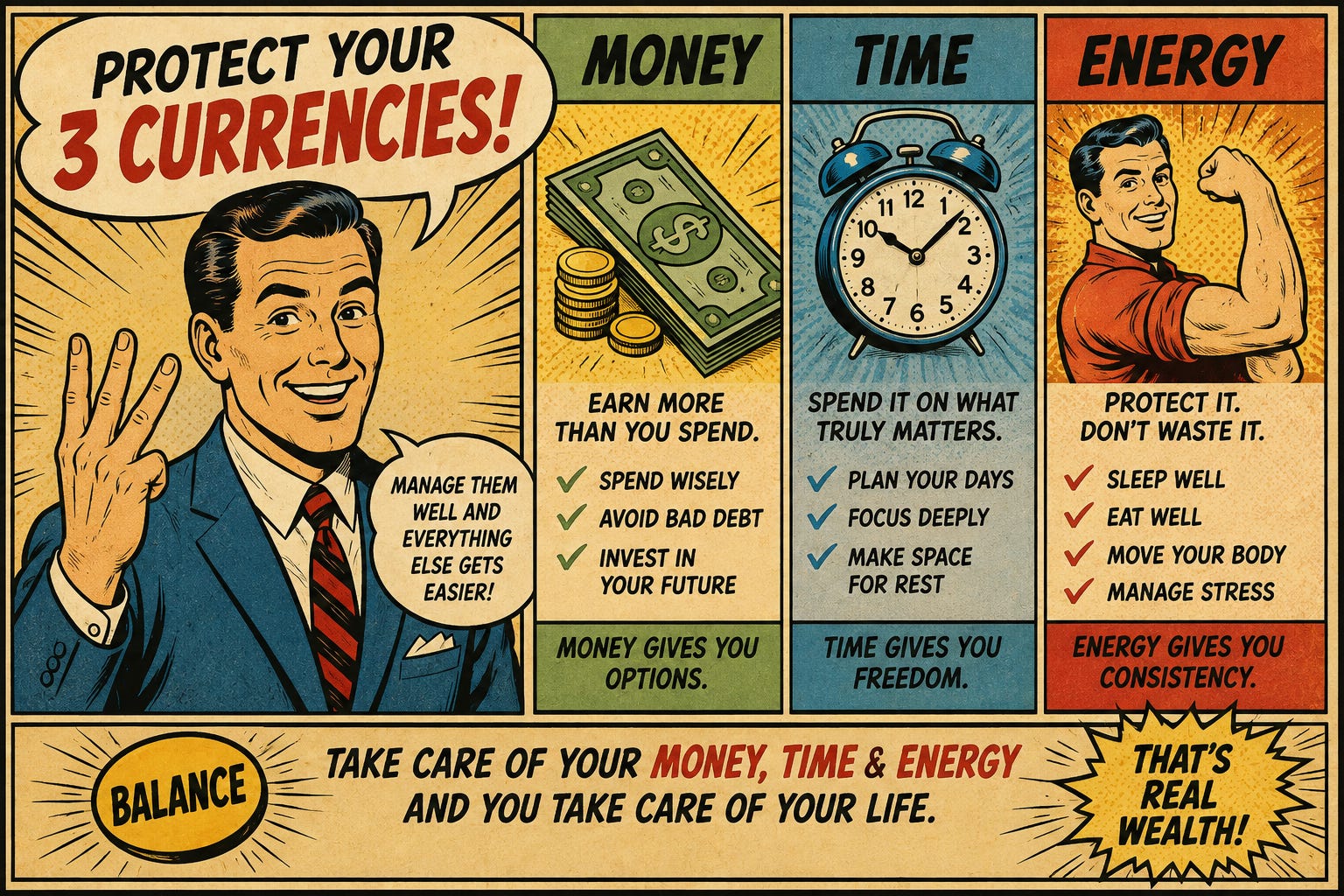
The more I think about this principle, the less I think it applies exclusively to money. Time works in almost exactly the same way. So does energy.
You can have a healthy bank balance and still live completely without margin. Every hour booked, every evening occupied, every weekend planned, every spare moment consumed by messages, notifications, work, errands and obligations.
Then something unexpected happens and there’s nowhere for it to go.
That’s the time equivalent of living pay cheque to pay cheque.
I think we need spare capacity. That’s one reason I like systems such as my whiteboards. They help me see what actually matters and, just as importantly, what doesn’t need doing today.
Something can move from daily to weekly. Weekly can become monthly. A project can wait. A goal can change. An empty afternoon doesn’t automatically need filling.
Efficiency isn’t about squeezing maximum output from every available minute. Sometimes the efficient thing to do is deliberately leave some minutes alone.
Energy has a balance sheet too
Energy is even easier to overspend because there’s no banking app showing you the cash balance or clock/watch to check the time.
Work, stress, poor sleep, constant decisions, exercise without recovery, social obligations and phones that ensure nobody is ever truly unavailable can all draw from the same account. You can keep borrowing against your own energy for quite a while.
Eventually the bill arrives.
Maybe your work suffers. Maybe your health does. Maybe you become increasingly unpleasant to live with. Usually the body finds some way of informing you that your accounting system was optimistic.
Again, I’m not interested in optimising myself into some kind of permanently hydrated productivity machine. I just think it’s useful to notice when the equation stops working.
I increasingly think about margin in three forms: money, time and energy.
Having a little extra of each makes life far more resilient.
Don’t become rich at the expense of having a life
There is an obvious trap in all of this. Taken too far, earn more than you spend becomes an excuse to postpone living indefinitely.
No holidays, no nice meals, no hobbies, no spontaneous purchases — just another thirty years of optimising the spreadsheet while waiting for some future version of yourself to finally have permission to enjoy the money.
That isn’t the point.
Spend money on things you love. Travel. Eat good food. Collect things. Have experiences. Buy something ridiculous occasionally if it genuinely makes you happy.
But make the decision consciously.
I’d rather spend a large amount of money on something that creates a memory I’ll keep for twenty years than quietly lose the same amount over twelve months on things I barely remember purchasing.
The goal isn’t to spend as little as possible. It’s to make sure your money, time and energy are going somewhere you actually chose.
Start with the gap
So if your finances feel complicated, perhaps simplify the question.
What comes in, what goes out, and what can you do to increase the difference?
Cut the things that don’t matter. Clear expensive debt. Keep your largest costs sensible when you can. Build valuable skills and increase your earning power. Then, when your income rises, resist the remarkably human urge to immediately create enough new expenditure to absorb all of it.
Protect the gap and put it to work.
At first, the difference might be £50 a month. Later it might be £200, then £500, and perhaps eventually considerably more. The numbers aren’t really the interesting part.
The interesting part is what gradually happens to your life.
A surprise expense becomes annoying rather than terrifying. You stop desperately needing every pay cheque the moment it arrives. You can walk away from things that don’t suit you. You can wait. You can choose.
That’s when the gap stops looking like a number in a bank account.
It starts looking like freedom.
Wealth isn’t built by earning more alone. It’s built by keeping enough of what you earn to change your future.