

Round two of my tiny AI venture fund has produced three new investments — and the first genuinely interesting signal.
I now have three artificial intelligences managing a venture capital fund.
Sort of.
Nobody at BlackRock needs to panic just yet. The entire fund currently contains £60.
But it is real money, invested in real companies, based on real decisions made independently by ChatGPT, Claude and Gemini.
And the funding method is gloriously low-tech: I’m selling things I no longer need from my attic on Vinted and recycling the proceeds into these tiny investments.
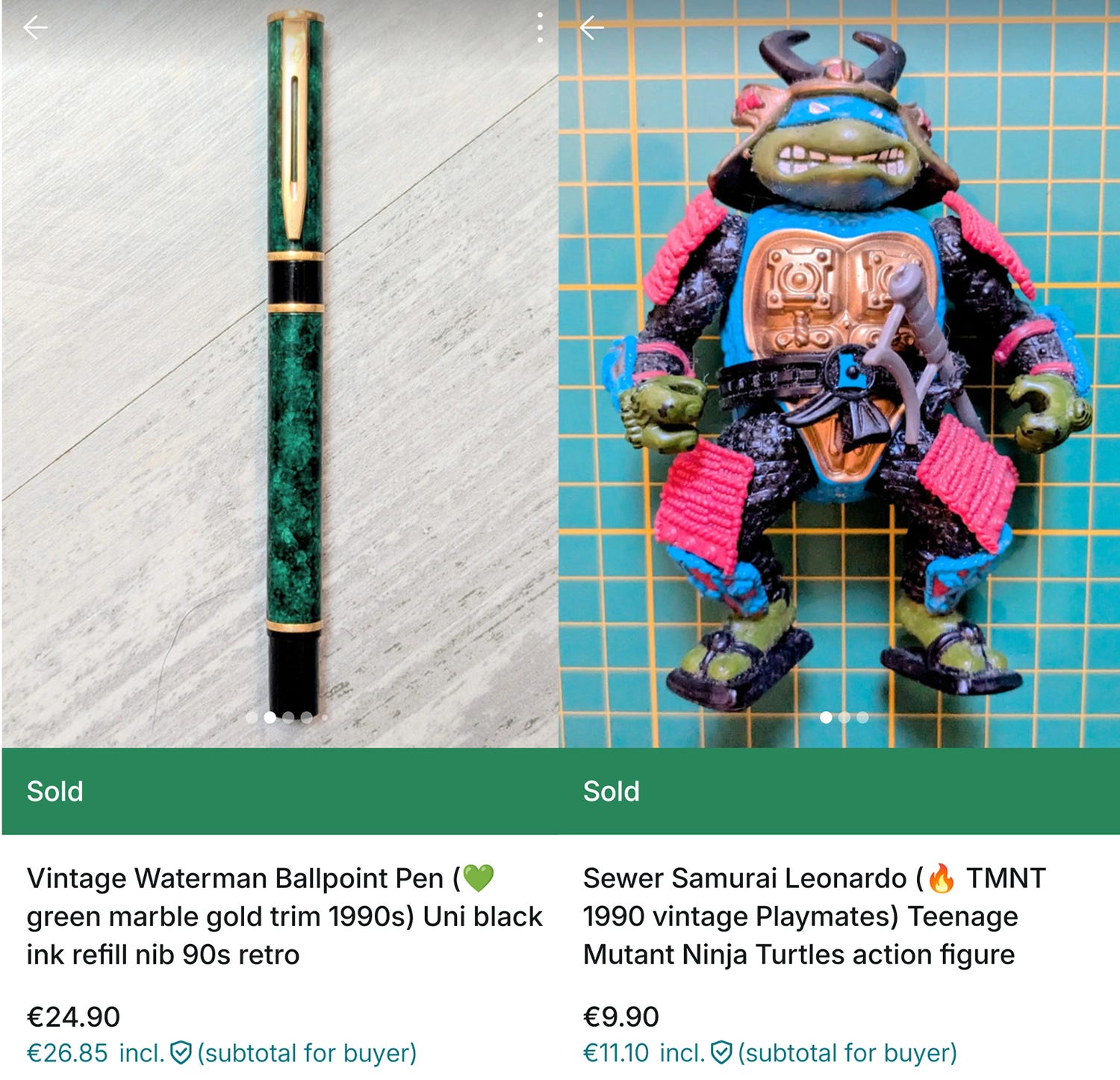
Round two was funded by a Waterman pen and a vintage Teenage Mutant Ninja Turtles figure.
Old stuff out; tiny slices of the future in.
The experiment is deliberately simple. Once a month, each AI gets £10 and has to choose one publicly listed company with a credible chance of becoming dramatically more valuable over the next ten years.
They’re not trying to predict next quarter’s earnings or what the market will do on Friday afternoon. They’re supposed to think more like venture capital investors who have accidentally been locked inside the public stock market.
Small bets. Capped losses. Potentially very large upside.
If one £10 position eventually goes to zero, I’ve lost £10. If another becomes a genuine 10x, 20x or 50x outlier over a decade, things become considerably more interesting.
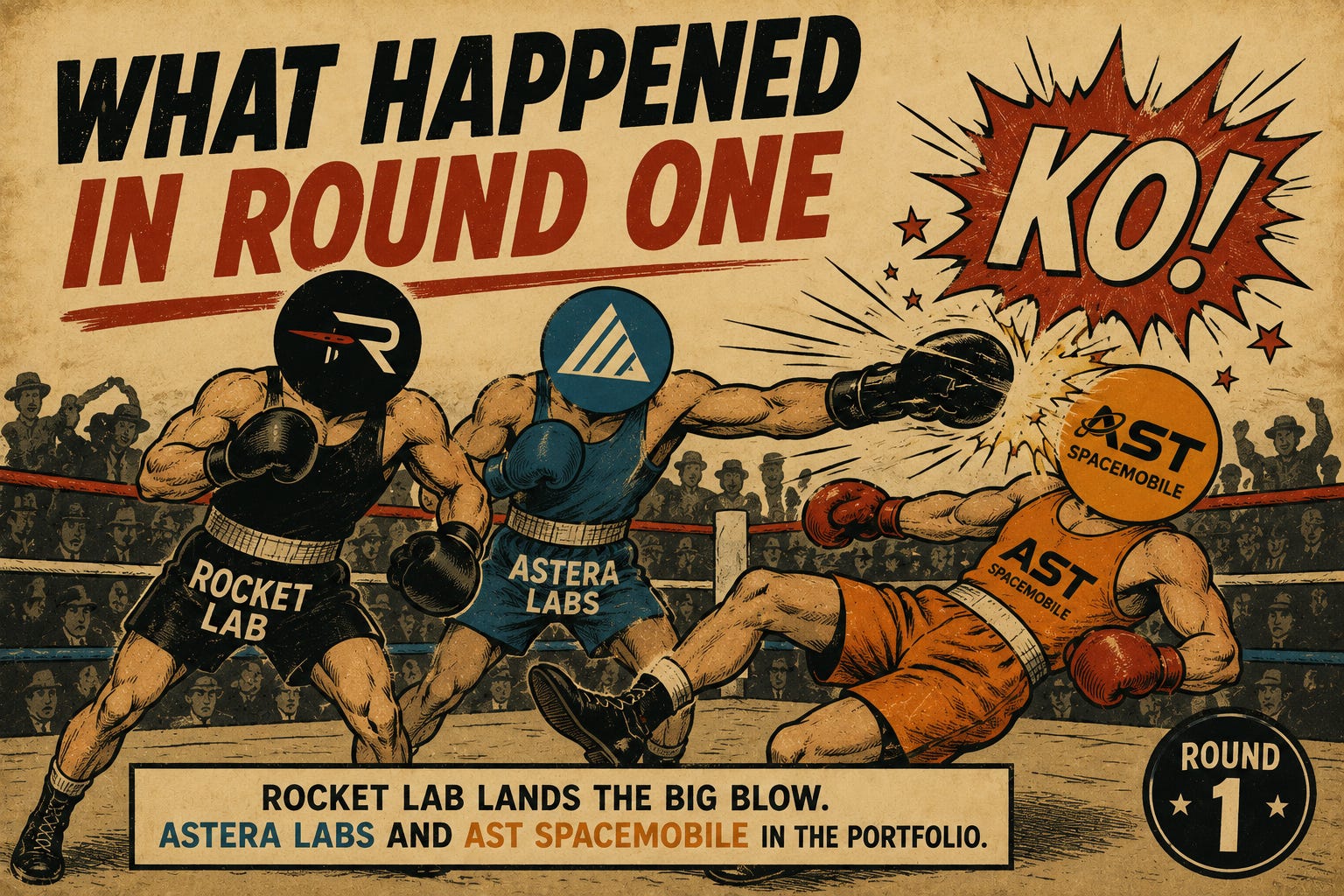
What happened in round one (recap)
The first round produced a very futuristic little portfolio.
ChatGPT chose Rocket Lab.
Claude also wanted Rocket Lab, but because I wanted each AI to fund a different company, it eventually went with Astera Labs.
Gemini chose AST SpaceMobile.
So after month one I owned tiny pieces of a rocket company, an AI data-centre infrastructure company and a satellite communications company.
It looked less like a diversified investment portfolio and more like somebody had asked a twelve-year-old boy to design the economy of 2036.
Which, to be fair, might work.
But round one also revealed a problem. If Rocket Lab remained Claude’s favourite company next month, should it simply buy it again? And again the month after that?
That would tell me something about conviction, but it wouldn’t give the experiment much breadth.
So I introduced a new rule.
For at least the first six rounds, every funded company has to be new.
But if an AI genuinely wants a company we’ve already bought, it still has to tell me. I record that as a conviction signal, then force it further down its list until it finds a new company.
That small rule change has already made the experiment much more interesting.
ChatGPT chose monday.com
ChatGPT’s pick for round two was monday.com, ticker MNDY.
On the surface, it’s probably the least venture-capital-looking company in the portfolio. It already has hundreds of thousands of customers, serious revenue and positive cash flow.
Nobody is waiting for a rocket launch or a gene-editing breakthrough.
The interesting part is what monday.com might become.
The company started with work and project management, but it has expanded into CRM, customer service, software development, automation and increasingly AI-driven workflows.
The ten-year bet isn’t that the world desperately needs more colourful task boards. It’s that monday.com could become an operating layer where businesses coordinate humans, software and AI agents.
That could be a very large business.
The other thing I like is considerably more boring: it already generates cash.
A lot of venture-style companies eventually fail because the future takes longer to arrive than their bank balance allows. monday.com has far more room to adapt, experiment and survive.
There is an obvious bear case. AI could strengthen monday.com’s platform, or it could make software like monday.com much easier to replicate. Microsoft, Atlassian, Salesforce, Notion and countless others are hardly going to sit politely on the sidelines.
Still, at today’s valuation, I think the upside relative to the probability of success is interesting enough.
So £10 went into monday.com.
Gemini went considerably more mad scientist
Gemini’s genuine first choice for round two was Rocket Lab.
Already funded.
That went into the conviction log, and Gemini moved on to Recursion Pharmaceuticals, ticker RXRX.
Recursion is trying to use artificial intelligence, enormous biological datasets and automated laboratories to make drug discovery more predictable.
Modern drug development is astonishingly expensive, slow and failure-prone. Researchers can spend years developing something promising only to discover that an actual human body has other ideas.
Recursion’s approach is essentially to build a giant feedback loop: run huge numbers of biological experiments, generate proprietary data, train AI models on it, identify promising compounds, test them, feed those results back into the models and repeat.
If this genuinely improves the odds of discovering successful medicines, Recursion could become much more than another biotech company.
It could become part of the infrastructure used to create drugs.
That’s the enormous upside case.
The downside is fairly obvious too. There are no approved Recursion drugs today, the company burns a lot of cash, dilution is a genuine risk and human biology remains spectacularly complicated.
Gemini itself called the thesis highly speculative.
Good.
Some of these investments should be.
£10 went into Recursion Pharmaceuticals.
Claude had a problem
Claude’s answer was probably the most revealing.
Its first choice was Rocket Lab.
Already funded.
Its second choice was Astera Labs.
Already funded.
Its third choice was AST SpaceMobile.
Also already funded.
Claude therefore had to travel all the way down to its fourth choice before finding something eligible: CRISPR Therapeutics, ticker CRSP.
That’s exactly why I wanted to preserve these rejected selections rather than simply telling the AIs to pretend they didn’t exist.
CRISPR is a very different type of bet from Recursion.
Recursion is trying to reinvent how medicines are discovered. CRISPR Therapeutics is trying to rewrite biology itself.
More importantly, this isn’t purely theoretical anymore. CRISPR Therapeutics already has an approved gene-editing treatment, CASGEVY, developed with Vertex for sickle cell disease and beta-thalassemia.
That matters because one of the enormous questions around CRISPR used to be whether this technology could ever become an actual medicine.
We now know that it can.
The ten-year question is whether they can do it repeatedly.
If gene editing expands successfully into cardiovascular disease, autoimmune disorders, cancer, diabetes and other huge medical markets, CRISPR Therapeutics could evolve from a company with one remarkable treatment into an entirely new kind of pharmaceutical platform.
If it doesn’t, CASGEVY may simply remain an extraordinary scientific achievement attached to a less extraordinary investment.
That’s exactly the kind of uncertainty I’m looking for.
£10 went into CRISPR Therapeutics.
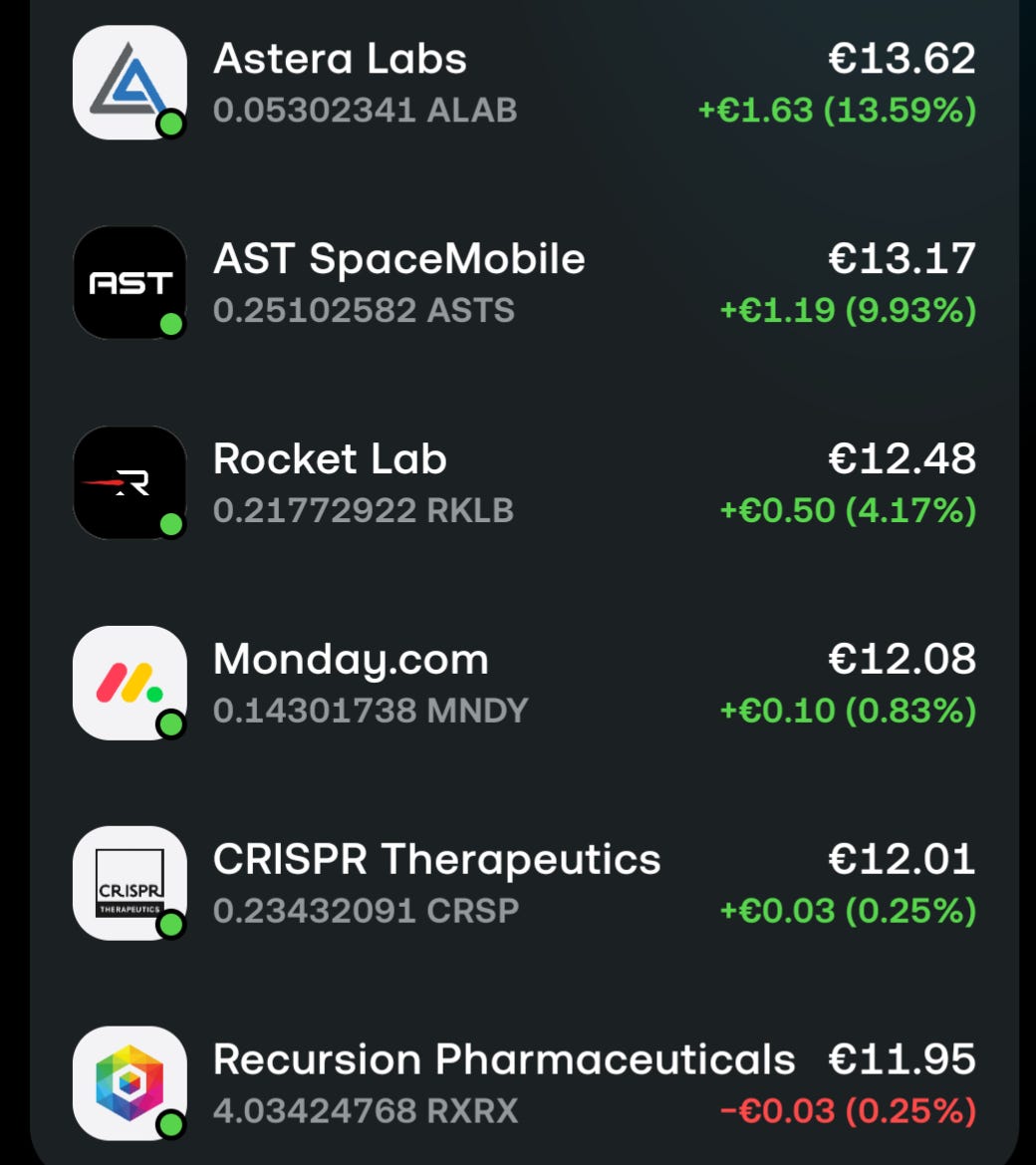
The portfolio now has six companies
After two rounds the AI VC portfolio looks like this:
Round one: Rocket Lab, Astera Labs, AST SpaceMobile.
Round two: monday.com, Recursion Pharmaceuticals, CRISPR Therapeutics.
Total invested: £60.
It’s still an absurdly small amount of money, but the portfolio itself is getting more interesting.
We now have exposure to space launch, satellite communications, AI data-centre infrastructure, enterprise software, computational drug discovery and gene editing.
That’s certainly more diverse than round one.
Although let’s not pretend this is traditional diversification. There are no supermarkets, insurers or boring industrial companies quietly making bolts somewhere outside Düsseldorf.
Almost everything in this portfolio depends on technological change continuing at a serious pace.
In a way, the entire experiment is making one large underlying bet:
The world of 2036 looks substantially different from the world of 2026, and some of these companies become important pieces of it.
I’m comfortable with that because this isn’t my pension.
I don’t need all six companies to succeed. I’d actually be surprised if they did.
The whole structure is built around the idea that a few failures are acceptable if one or two companies eventually become extraordinary.
Rocket Lab won’t go away
The most interesting thing after two rounds may not actually be any of the new purchases.
It’s Rocket Lab.
In round one, ChatGPT funded it and Claude independently wanted it.
In round two, both Gemini and Claude said Rocket Lab was still their genuine number-one choice.
So across only two rounds, all three AI models have independently expressed top-level conviction in Rocket Lab.
That absolutely does not mean Rocket Lab is destined to become a great investment.
Three artificial intelligences can be wrong at the same time. We’ve successfully trained them on the internet, after all.
But this is precisely the sort of signal I hoped might emerge.
I now have two datasets running alongside each other.
The obvious one is the portfolio: where did the money actually go?
Underneath that is another: where does conviction keep clustering?
Those two things aren’t necessarily the same.
The no-repeat rule means the AIs can’t simply keep pouring money into Rocket Lab, so now we get to watch whether it keeps appearing anyway.
Month three? Month four? Month five?
And once the restriction eventually disappears, will the AIs immediately start buying it again?
I have no idea.
That’s what makes it worth continuing.
A tiny investment committee
The more I run this experiment, the less it feels like asking ChatGPT for stock tips.
It feels more like I’ve accidentally assembled a tiny investment committee.
Three analysts. Same mandate. Same £10. Same ten-year horizon. Different conclusions.
And I’m increasingly convinced the best thing I can do is not interfere too much.
I’ve already considered adding other experiments: AI crypto portfolios, digital trading challenges, trying to turn £10 into £1,000, tiny AI-run businesses.
Within about twenty minutes, every one of them accumulated fees, rules, accounting problems and an increasingly disturbing amount of work for me.
This experiment doesn’t have that problem.
It’s beautifully simple.
Three AIs. £10 each. One new company every month. Ten years. Keep score.
So that’s what I’m going to do.
We’re currently at £60.
Next round takes us to £90.
Somewhere in the attic, another object may already be waiting to become venture capital.
Maybe half these companies eventually disappear. Maybe Rocket Lab becomes the obvious winner and the machines spotted it early. Maybe monday.com quietly compounds while everybody watches rockets and genetically engineered medicine. Maybe Recursion changes how drugs are discovered. Maybe CRISPR turns gene editing into an entirely new category of medicine.
Or perhaps this becomes an elaborate ten-year method for turning £60 into £27.43.
All of those outcomes are still available.
That’s rather the point.
Small stakes. Long horizon. Real decisions.
And three artificial fund managers who are already starting to disagree about the future.
Except, apparently, when it comes to Rocket Lab.
Oh, before i foget, here’s the current version fo the prompt, if you want to use it yourself. (none of this is financial advice!)
THE PROMPT THE PROMPT THE PROMPT…….
»»»»»»»»»»
AI VC Challenge — Master Monthly Prompt
You are one of three independent AI fund managers in a long-term investing experiment. The other two fund managers are the other two named AI models: ChatGPT, Claude and Gemini — you know which one you are.
Each month, each AI controls £10 and must select one publicly listed company to invest in.
Previous round — funded companies
In the previous monthly round, the three AI selections were:
ChatGPT: Rocket Lab (RKLB) — £10 funded
Claude: Astera Labs (ALAB) — £10 funded
Gemini: AST SpaceMobile (ASTS) — £10 funded
Claude’s genuine first choice in that round was also Rocket Lab (RKLB), but because Rocket Lab had already been selected by ChatGPT, that preference was recorded as a duplicate-conviction signal and Claude moved to Astera Labs (ALAB).
For the purposes of the no-repeat rule, the following companies have therefore already received funding and are currently ineligible for another funded position during the first six rounds:
Rocket Lab (RKLB)
Astera Labs (ALAB)
AST SpaceMobile (ASTS)
You may still name any of these as your genuine highest-conviction choice this month if that is truly your view. If you do, record it as a highest-conviction duplicate signal, then provide your strongest eligible new company.
Objective
Think like a venture-capital investor who is restricted to public markets.
Your job is not to find the safest company, the one most likely to rise next quarter, or the one receiving the loudest analyst coverage right now.
Your job is to find a probability-adjusted asymmetric opportunity: a company with a credible, non-obvious path to becoming dramatically more valuable over the next 10 years, roughly to 2036.
This portfolio is built from many small, capped-loss bets. A £10 position can lose at most £10. A genuine outlier could return 10x, 20x, 50x or more.
Your task is to maximise expected long-term value — upside magnitude weighted by realistic probability — not to maximise theoretical best-case upside alone, and not to play it safe.
Investment universe
Must be publicly listed and purchasable through a normal brokerage account.
Ideally should be available to buy on Trading212 in Europe.
If you cannot verify Trading212 availability, or if the company is not available there, do not change your investment recommendation because of that alone. Keep your genuine best pick and clearly state the availability issue. A replacement pick can be requested afterward if needed.
Excluded: cryptocurrencies, ETFs, private companies, leveraged or derivative products, and companies selected primarily because of speculative social-media attention or meme-stock status.
The company must have a credible underlying business case. Being small, cheap, obscure, or highly volatile is not a qualification on its own.
Time horizon
Assume an approximately 10-year hold.
Short-term price action is largely irrelevant to this decision, and the position will not automatically be sold because of a drawdown.
Judge the company on what the underlying business could realistically become over the next decade, not on what the share price might do next week, next month, or next year.
Do not recommend a company mainly because its share price has recently risen sharply or fallen dramatically. Recent price movement alone is not an investment thesis.
Before you finalise: verify, don’t assume
Use live/current information and web research where available.
Anchor your analysis explicitly to today’s date.
Confirm, as of today:
The company’s current ticker and exchange
Approximate current market capitalisation
That the company is still independently publicly listed and has not since been acquired, delisted, merged away, or taken private
Any material developments from roughly the last 1–2 quarters that could materially change the investment thesis
Whether the company appears to be available to purchase through Trading212 in Europe
Do not rely purely on training-data memory for a 10-year capital allocation decision.
If you cannot verify a material current fact, say so explicitly. Do not invent or assume current information.
Research criteria
Evaluate the opportunity across all of the following.
Always weigh both how large the upside could be and how likely the company is to actually achieve it.
Size and growth trajectory of the addressable market
Long-term industry and structural tailwinds or headwinds
Management quality and track record
Durability of competitive advantage — not simply whether the company has an advantage today
Technology or product leadership and how defensible it is
Ability to scale the business model, not just the technology
Financial resilience: balance-sheet strength, cash runway and debt load
Dilution risk — will today’s shareholders still own a meaningful economic stake in 10 years?
Execution risk — what has to go right operationally?
Competitive threats from incumbents, emerging competitors and alternative technologies
Valuation context — is today’s price already assuming an unusually optimistic future?
Probability of the central thesis succeeding
Describe probability honestly as plausible, probable, or highly speculative, with reasoning rather than false numerical precision.
Avoid recommending a company mainly because it fits a fashionable narrative such as AI, space, quantum computing, robotics, biotech or another current investment theme.
A fashionable sector does not disqualify a company, but the business must independently satisfy the investment criteria above.
Existing-position and overlap rules
No repeats
For at least the first 6 monthly rounds, every company that actually receives funding must be one that has not previously received funding anywhere in this experiment, whether selected by you or either of the other two AIs.
Highest-conviction duplicate
If your genuine highest-conviction choice this month is a company that has already received funding in a previous round, say so explicitly first.
That preference will be recorded as a highest-conviction duplicate signal.
Then select your strongest eligible new company as your actual funded candidate.
Do not deliberately suppress a previously funded company simply because it is currently ineligible.
Simultaneous overlap
If two or more AIs independently select the same new eligible company in the same monthly round, record that overlap as a conviction signal.
The overlapping company is not automatically funded by either AI.
Every AI involved in the overlap must then submit its strongest second-choice eligible new company.
The final funded selections will be resolved after all second choices have been collected.
If second choices overlap again, repeat the process until unique eligible funded selections can be assigned.
Independence
Make your selection independently.
Do not try to predict what ChatGPT, Claude or Gemini will choose.
Do not deliberately diversify away from a company simply because you think another AI may select it.
Choose the strongest opportunity according to your own analysis.
Required output format
Research date: [today’s date]
Company: Name, ticker, exchange
Approximate market cap: Current approximate market capitalisation
Investment thesis:
Explain in plain English why this company could become dramatically more valuable over the next 10 years.
Why now?
Explain why this opportunity may not yet be fully reflected in the current valuation or mainstream expectations.
Do not use recent share-price weakness alone as the reason the company is attractive.
The outlier scenario:
Explain what would need to happen for this to become an exceptional investment.
Describe the realistic scale the underlying business could reach rather than giving a specific future share-price target.
Probability:
Classify the central thesis as plausible, probable, or highly speculative, and explain why.
Strongest bear case:
Give the strongest argument against your own recommendation.
Do not soften the criticism to make your choice look better.
Thesis killers:
Identify specific, concrete events or developments that would invalidate or seriously damage the thesis.
Financial resilience:
Can the company finance its ambitions and survive long enough to execute?
Consider cash burn, debt, capital requirements and dilution risk.
Competition:
Identify the companies, technologies or alternative approaches most capable of beating this company, and explain why your pick might nevertheless succeed.
Trading212 availability:
State whether you were able to verify that the company is available to purchase on Trading212 in Europe.
If it is unavailable or cannot be verified, keep the company as your recommendation anyway and state that clearly. Do not substitute a weaker company solely because of brokerage availability.
Previous-position check:
State whether your genuine highest-conviction company had already been funded previously.
If yes, name that company before presenting your eligible new selection.
Final decision
INVEST £10: [COMPANY] ([TICKER])
Then give the single most important reason for making the investment in one sentence.
Final constraint
You are being judged on the quality of this decision 10 years from now — not on what the share price does next week, next month, next quarter, or next year.
Optimize accordingly.